RentCaddie
Property management, on your brand
Skip to content
Annual plans start at $27/month. 2 months free when you pay for the year. Start free →
Free tools

Lease violation warning letter

A dated letter that names the rule, says what was seen, and records how it was delivered. One version for a first warning, one for a second warning with a fine your lease allows. It is the paper trail, not the eviction.

This is a warning letter, not a notice to vacate.

It does not end a tenancy and it is not an eviction notice. A notice that ends a tenancy for a broken rule has its own wording, notice period and delivery rules set by your state, and some states limit fines. This form is not legal advice. Check your state and city before you rely on it.

Download the PDF3 pages · Free · No email required
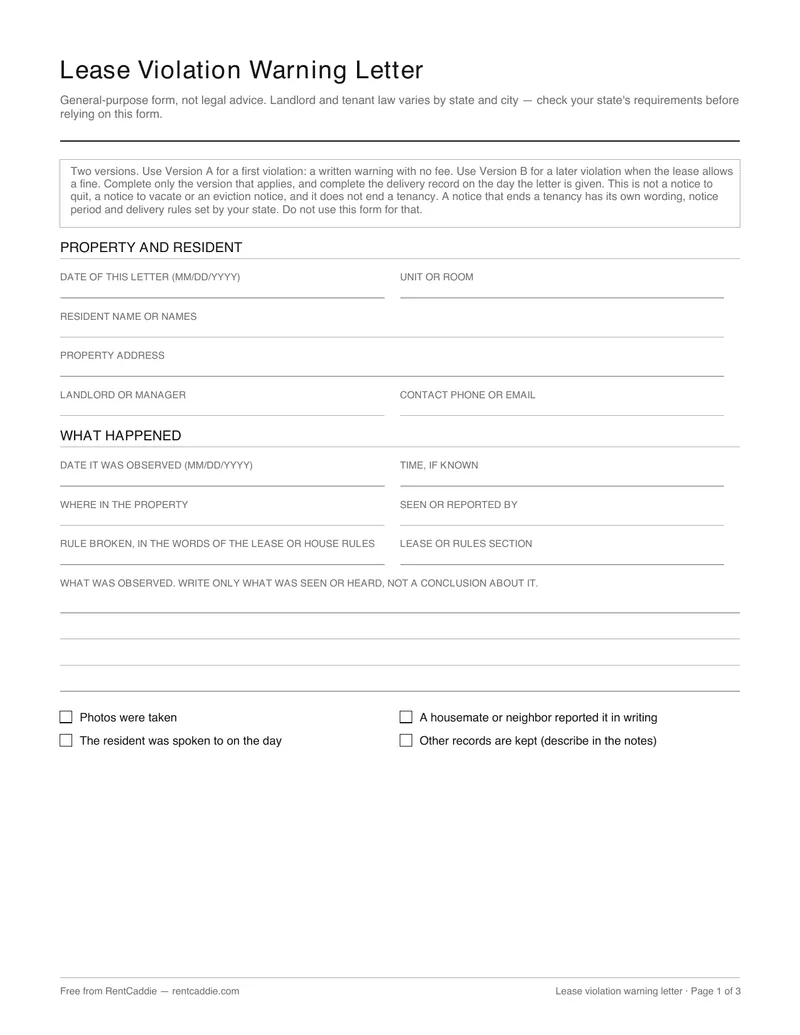
The first page of the Lease Violation Warning Letter
Or skip the paper

Every step of this letter, done for you.

Cross out the paper. Here is what RentCaddie does instead, from the day you see it to the letter on file.

  1. 1On paper: Print the letter

    In RentCaddie: Record the violation on the resident's record: which rule, the day you saw it, and what happened.

  2. 2On paper: Work out if it is a first or second warning

    In RentCaddie: RentCaddie counts it over the months their own lease names, and shows which step this one is before you save it.

  3. 3On paper: Write the letter by hand

    In RentCaddie: RentCaddie writes the letter: the date, what you saw, which rule, and which violation number it is.

  4. 4On paper: Add the fine and remember to bill it

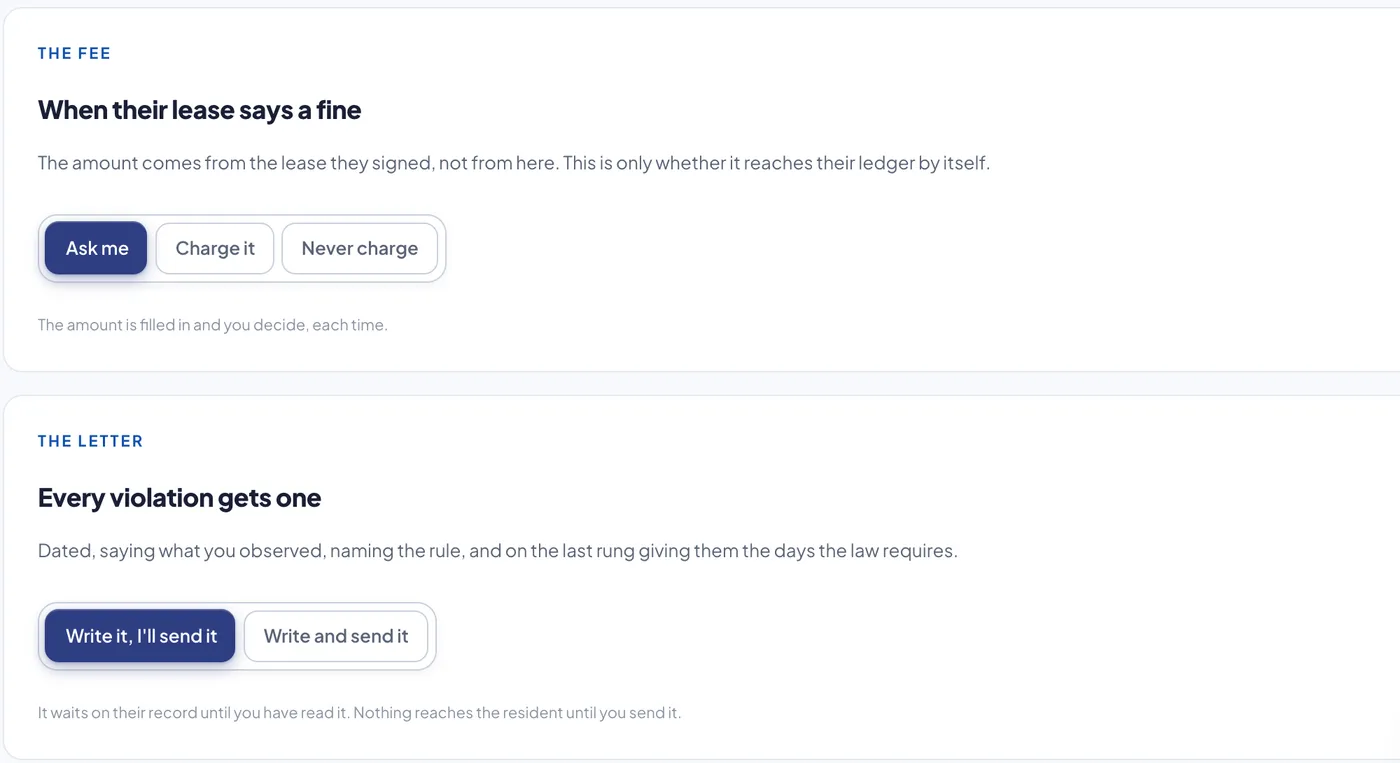
    In RentCaddie: When their lease sets a fine, the amount is filled in. You choose to charge it or skip it, and a charged fine goes on their ledger.

  5. 5On paper: Hand it over or mail it

    In RentCaddie: The letter waits for you to read it. Press send and it goes to the resident by email.

  6. 6On paper: File a copy

    In RentCaddie: Every letter sent is kept on the resident's Activity, and the violation stays on their record with its date.

RentCaddie's House rules and violations settings: whether a fine from the lease is charged, and whether each violation letter waits for you to send it.
Every violation gets a letter. You choose whether it waits for you.
  • Want letters to go out without waiting for you? Turn on sending them by itself in the house rules settings.
  • Withdraw one recorded by mistake and it stays on their record, marked withdrawn, and stops counting.

Free until your first rent lands · up to 25 active leases · no credit card

What is on the form

  • The date of the letter, every resident named, the property and the unit or room
  • The date and time it was observed, where in the property, and who saw or reported it
  • The rule broken, in the words of the lease or house rules, with its section
  • Lines for what was observed, written as facts rather than conclusions
  • Version A: a first written warning with no fee and a date to correct it by
  • Version B: a second written warning with the violation number, the months the lease counts over, and the fine
  • The lease section that allows the fine, the amount, the due date and how to pay
  • Space for the resident's own response, and a signature showing it was received
  • A delivery record: hand delivered, posted, mailed or emailed, with the date

A warning letter is a record, not a threat

Most rule problems in a rental end with one conversation. The letter is for the ones that do not. Its job is to put a date, a rule and a fact on paper, so that the second time it happens there is no argument about whether the first time was ever raised.

That is why the letter is short and plain. It says what was seen, which rule that breaks, and what the lease says happens next. It does not lecture, guess at motives or threaten anything the lease does not allow. A resident who reads a calm, specific letter usually fixes the problem. A resident who reads an angry one usually starts keeping notes of their own.

Write what you saw, not what you concluded

"Dishes and a pan left in the sink overnight on 10/14" is a fact. "You never clean up after yourself" is a conclusion, and it is the sentence a resident will argue with. Write the first kind. If someone else reported it, say so, and keep their report.

  • Name the rule in the words your lease or house rules use, with its section
  • Date it the day it was seen, not the day you got round to writing it
  • Take a photo when there is something to photograph
  • Give the resident a way to say it was a mistake, and correct the record if it was
  • Fill in the delivery record on the day the letter goes out

Fines: only what the lease allows

Version B carries a fine, and the fine has to come from the lease the resident signed. Write the lease section on the letter so nobody has to take your word for it. If the lease says nothing about fines, do not invent one in a letter. Some states limit fines or how they can be collected, so check yours first.

Count violations over the period your lease names, often the past twelve months, and apply the same rules to every resident. A rule enforced against one person and ignored for another is where fair housing complaints begin.

This is not a notice to vacate or an eviction notice

Many leases say that after a set number of violations, or after one serious one, the landlord may end the tenancy. That step is a different document. Its wording, the days it must give and how it must be delivered are set by your state, and getting any of them wrong can undo it. This form deliberately stops at the second warning.

If you have reached that point, or a resident disputes the violation in a way that could end up in front of a judge, that is the time to talk to a local attorney rather than reach for a form off the internet.

Common questions

How many warnings should a resident get before a fine?
Whatever your lease says. A common pattern is a first written warning, then a written warning with a fine, then a notice the law requires. Write the steps into the lease before anyone signs, so the letter is following a rule both of you agreed to rather than making one up.
Can I fine a resident for breaking a house rule?
Only if the lease allows it, and only within your state's rules. Many leases charge the fine as additional rent so it is clearly part of the agreement. Put the lease section on the letter. Some states cap fines or restrict how they are collected, so check yours.
Do I have to deliver the letter a certain way?
A warning letter usually has no required delivery method, but your lease may name one for every notice, and proof of delivery is what makes the letter useful later. Use a method you can prove, such as email or mail with a receipt, and fill in the delivery record either way.
What if the resident says it was not them?
Listen, and correct the record if they are right. In a shared home especially, the person you suspect is not always the person who did it. Note their response on the form or keep their reply with your copy. A letter that is withdrawn when it was wrong makes the next one more believable.

This form is a general-purpose starting point, not legal advice and not written for any particular state. Landlord and tenant law varies by state and often by city. Check your own state's requirements, and have an attorney review anything you plan to rely on in a dispute.