RentCaddie
Property management, on your brand
Skip to content
Annual plans start at $27/month. 2 months free when you pay for the year. Start free →
Free tools

Rent receipt template

Written proof that rent was paid, for the payments that leave no record of their own. A resident's copy, a matching copy for your files, and a numbered log so every receipt can be accounted for.

Download the PDF3 pages · Free · No email required
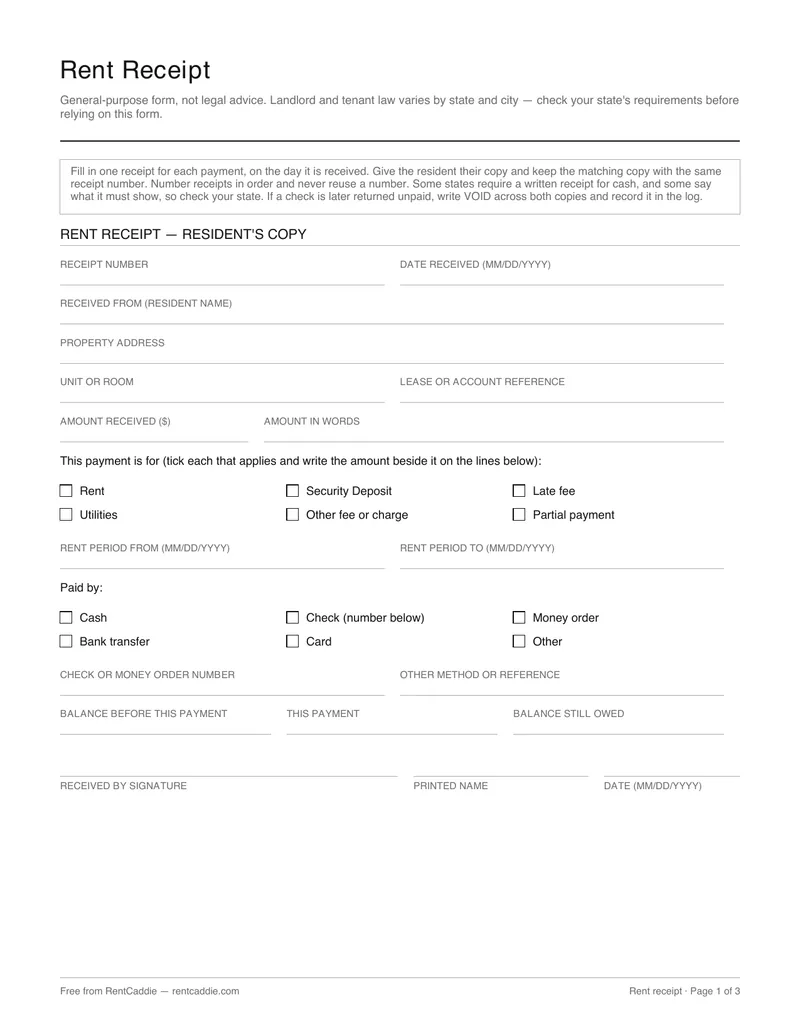
The first page of the Rent Receipt Template
Or skip the paper

Every step of this receipt, done for you.

Cross out the paper. Here is what RentCaddie does instead, from the moment money arrives.

  1. 1On paper: Write the receipt by hand

    In RentCaddie: Record a cash, check or Zelle payment once. The box to email your resident a receipt is already ticked.

  2. 2On paper: Fill in the amount and how they paid

    In RentCaddie: The receipt fills itself in: the amount, the date, how they paid and which charges it covered.

  3. 3On paper: Work out what is still owed

    In RentCaddie: It shows what is still owed after this payment, or that they are all paid up.

  4. 4On paper: Hand them their copy

    In RentCaddie: It is emailed to your resident in their own language, and a copy is kept on their record.

  5. 5On paper: Keep a copy for later

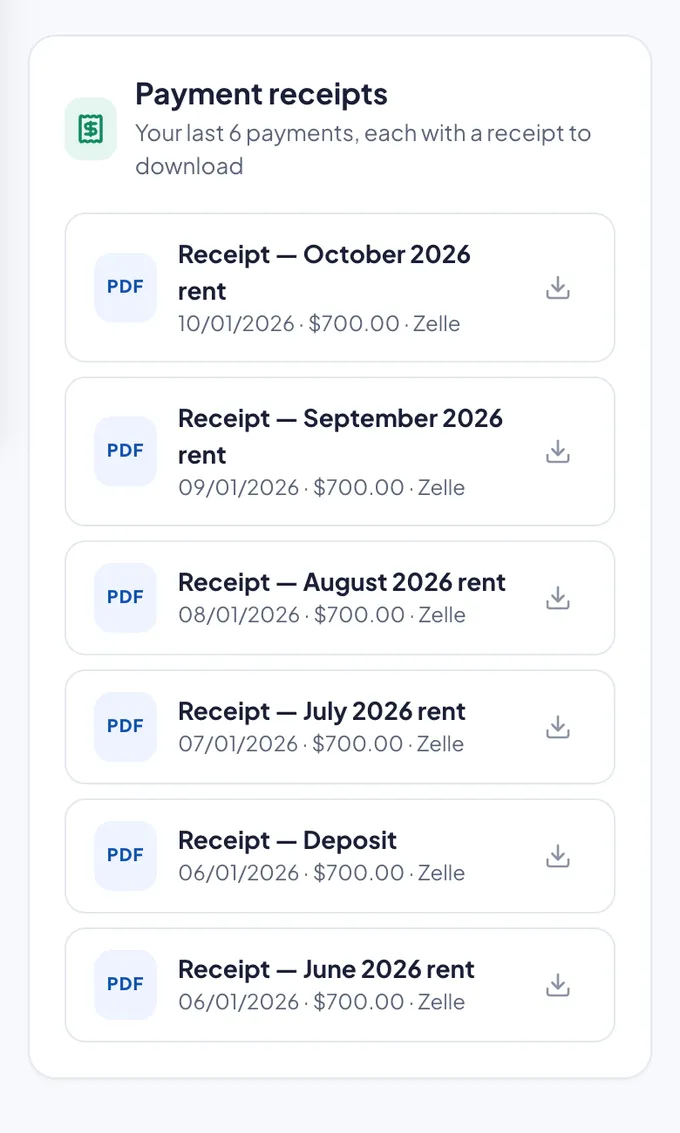
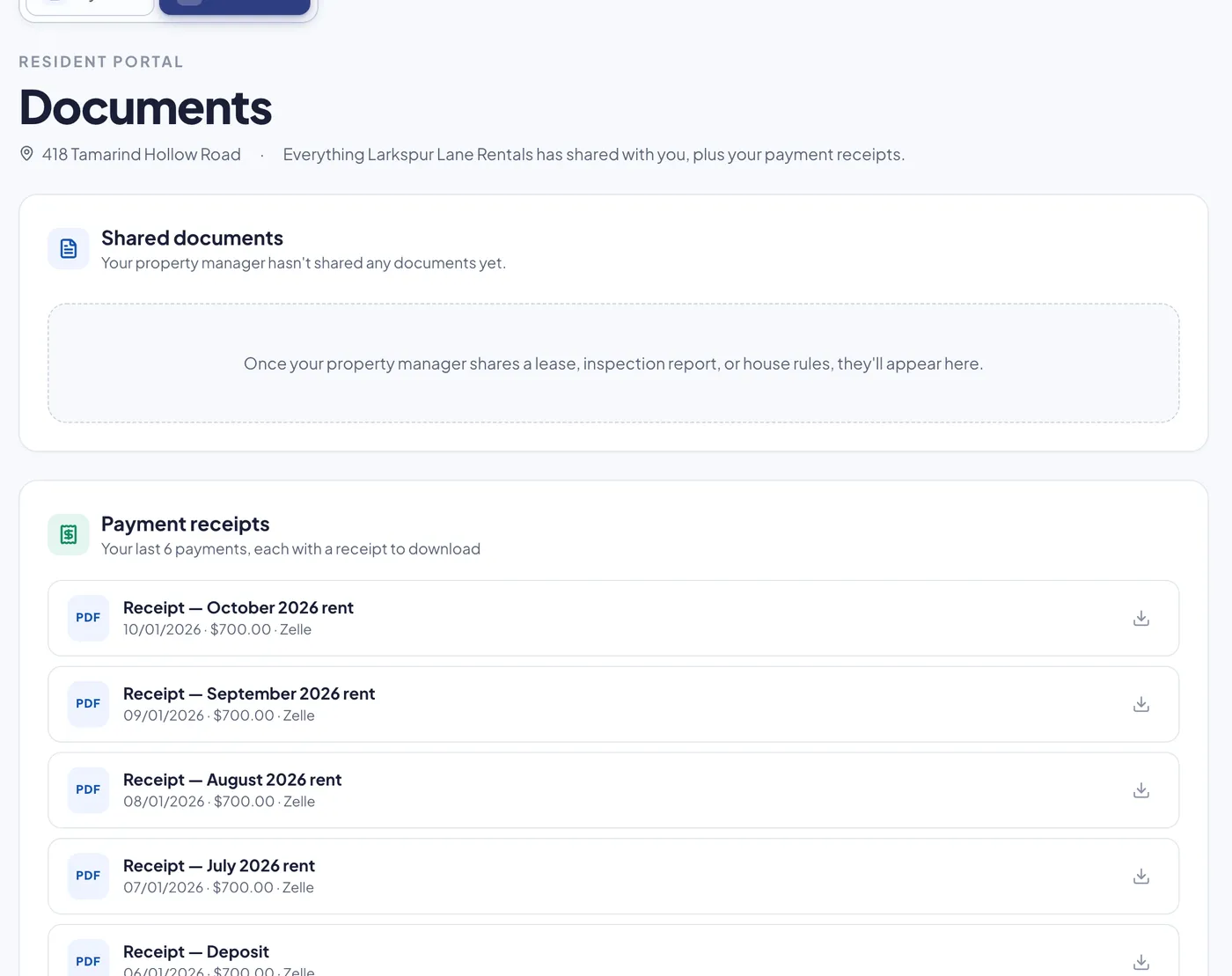
    In RentCaddie: Their recent payments are listed in their Documents, each with a receipt they can download on their phone.

  6. 6On paper: Void it when a check bounces

    In RentCaddie: A payment that was refunded or bounced loses its receipt, and a rent credit never gets one, so a receipt always means money you have.

A resident's Documents page in RentCaddie on a phone: their payment receipts by month, with the date, amount and how each was paid, each ready to download.
Every receipt, on your resident's phone.
  • Residents who pay online by card or bank have the payment recorded on their ledger by itself, against the charges they paid.

Free until your first rent lands · up to 25 active leases · no credit card

What is on the form

  • A receipt number and the date the money was received
  • Who paid, the property address, and the unit or room
  • The amount in figures and in words
  • What it paid for: rent, Security Deposit, late fee, utilities, other charges, or a partial payment
  • The rent period it covers
  • How it was paid, with the check or money order number
  • The balance before, this payment, and the balance still owed
  • A signature line for whoever received the money
  • A matching landlord's copy and a one-line-per-receipt log

When a rent receipt matters most

A bank transfer or a card payment leaves its own trail. Cash leaves none, and a money order or a check handed over in person leaves very little. A receipt written on the day turns "I paid you" into a dated record you and your resident both hold, which is worth far more than either memory when there is a disagreement months later about what was owed.

Some states require a landlord to give a written receipt for rent paid in cash, and some say what that receipt must show, such as the date, the amount, the period covered and who received it. Others leave it to the lease. Check your state, and if in doubt give a receipt for every payment that is not made electronically.

  • Write it on the day the money changes hands
  • Give the resident their copy and keep the matching one
  • Number receipts in order and never reuse a number
  • Record partial payments as partial, with the balance still owed

Partial payments, bounced checks and the Security Deposit

A partial payment is where receipts earn their keep. Tick partial payment, fill in the balance before and the balance still owed, and both of you know exactly where things stand. Be aware that in some states accepting part of the rent can affect a late notice or an eviction already under way, so check your state before you accept a partial payment in that situation.

If a check is returned unpaid, the receipt you wrote for it is no longer true. Write VOID across both copies, note it in the receipt log, and record the money as still owed. Keep a Security Deposit on its own line and never mix it into rent: in many states it is the resident's money that you are holding, it may need to sit in a separate account, and it is accounted for at move-out.

Keep the log with your books

The receipt log on the last page is one line for every receipt you write, in number order. A gap or a repeated number stands out at once, which protects you as much as your resident. At the end of the year the log is also the list your accountant needs of every payment received in cash or by check, ready to match against your bank deposits.

Common questions

Do I have to give a tenant a receipt for rent?
It depends on your state. Some require a written receipt for cash payments, and some require one whenever a tenant asks. Even where it is not required, a receipt for every cash, check or money order payment protects both of you if there is ever a dispute about what was paid.
What should a rent receipt include?
The date, a receipt number, who paid, the property and unit or room, the amount, what it paid for, the rent period covered, how it was paid, the balance still owed, and the signature of whoever received the money. Your state may require more, so check your state's rules.
Can a rent receipt be emailed instead of handed over?
Usually, yes, as long as your state and your lease allow written notices and records to be sent electronically, and the resident can keep a copy. Whatever form it takes, keep your own matching record so the receipt can be checked against your books later.
Should the Security Deposit go on a rent receipt?
Give it its own receipt or at least its own line. A Security Deposit is not rent: in many states it is the resident's money held by you, sometimes in a separate account, and some states require a written receipt for it. Mixing it with rent makes it harder to account for at move-out.

This form is a general-purpose starting point, not legal advice and not written for any particular state. Landlord and tenant law varies by state and often by city. Check your own state's requirements, and have an attorney review anything you plan to rely on in a dispute.