RentCaddie
Property management, on your brand
Annual plans start at $27/month. Save two months when you pay annually. Start your 14-day free trial →
Free tools

Move-in inspection checklist

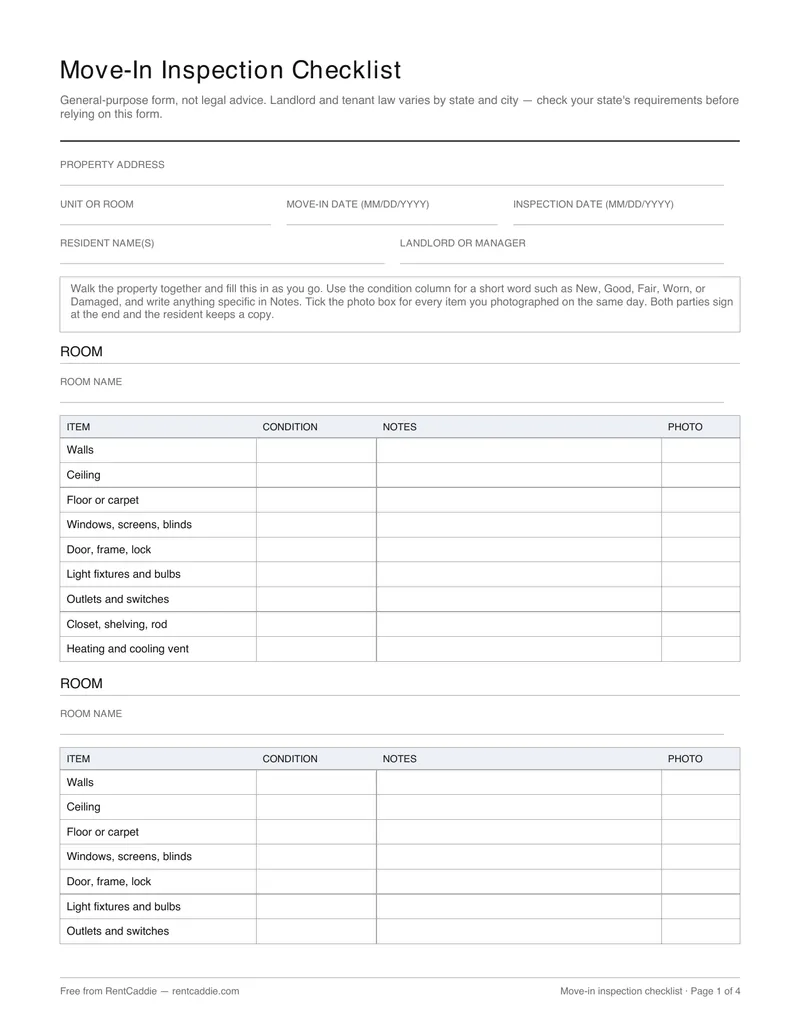
A blank, printable room-by-room walkthrough form. Record the condition of every room on day one, both of you sign it, and the security deposit argument at move-out has a document behind it instead of two memories.

Download the PDF4 pages · Free · No email required
What is on the form
  • A property, resident, and date header with space for the room or unit
  • Room-by-room rows covering walls, floors, ceiling, windows, doors, lighting, and outlets
  • Dedicated sections for the kitchen, each bathroom, and outside areas
  • A condition column, a notes column, and a tick box for whether a photo was taken
  • Keys, remotes, and access devices handed over, with counts
  • Smoke and carbon monoxide alarm checks
  • Utility meter readings at move-in
  • Signature and date lines for the landlord and every resident

Why the move-in form is the one that matters

Nearly every security deposit dispute is the same argument: was that mark on the wall already there? Without a signed record from day one, it is your word against theirs, and in most places the burden of proving damage sits with the landlord.

A move-in inspection signed by both of you converts that argument into a comparison. At move-out you are not asking who is telling the truth, you are holding two forms side by side. That is also why the photo column exists. A tick that says a photo was taken, dated the same day as the signed form, is worth more than a description written months later.

How to use it without it becoming a chore

Walk it with the resident rather than filling it in beforehand and asking them to sign. It takes about the same amount of time and it changes the meaning of the signature entirely: they are agreeing to something they watched you write, not to a form they skimmed on the doorstep with a box of their things in their arms.

Note the small stuff. A resident who sees you writing down a scuff they did not cause understands immediately that you will also write down one they did. Then give them a copy the same day, keep yours, and take the photos on the spot.

  • Walk it together, do not pre-fill it
  • Photograph anything you wrote a note against
  • Both sign and date, and give the resident a copy immediately
  • Store it where you will find it at move-out, not in a truck door pocket

Check your own state's requirements

Some states require a written move-in condition statement, set a deadline for providing it, or specify what has to be on it. Others leave it entirely to you. This form is a general-purpose starting point, not a legal document tailored to any jurisdiction, so check what your state requires and add anything it asks for before you rely on it.

Common questions

Is a move-in inspection legally required?

It depends on the state. Some require a written condition statement within a set number of days and some do not require one at all. Even where it is optional, it is the single most useful document you can hold when a deposit is disputed, so check your own state's rule and do it either way.

Do I need photos as well as the form?

Photos and the form do different jobs. The form is signed, which is what makes it evidence of agreement. The photos show condition in a way no written description can. Take both, on the same day, and note on the form which items you photographed.

What if the resident refuses to sign it?

Complete it anyway, note on the form that the resident was present and declined to sign, date it, and send them a copy in a way you can prove, such as email. An unsigned contemporaneous record with photos is far stronger than nothing.

How long should I keep it?

At minimum through the deposit return period after they move out, and realistically for as long as you keep any other lease record, because a deposit dispute can surface as a claim well after the tenancy ends. Keeping it with the lease rather than in a separate pile is the practical answer.

This form is a general-purpose starting point, not legal advice and not written for any particular state. Landlord and tenant law varies by state and often by city. Check your own state's requirements, and have an attorney review anything you plan to rely on in a dispute.
Or stop printing forms

The same walkthrough, on your phone, filed against the lease.

RentCaddie runs inspections from your phone with photos attached to each room, signatures from you and the resident, and the record saved against the lease so you can find it at move-out. Fourteen days free.