RentCaddie
Property management, on your brand
Skip to content
Annual plans start at $27/month. 2 months free when you pay for the year. Start free →
Free tools

Co-living house rules template

Most arguments in a shared house are about rules nobody wrote down. This fills that gap: the kitchen, the storage, the trash, guests, quiet hours, and what happens when somebody breaks a rule.

Download the PDF3 pages · Free · No email required
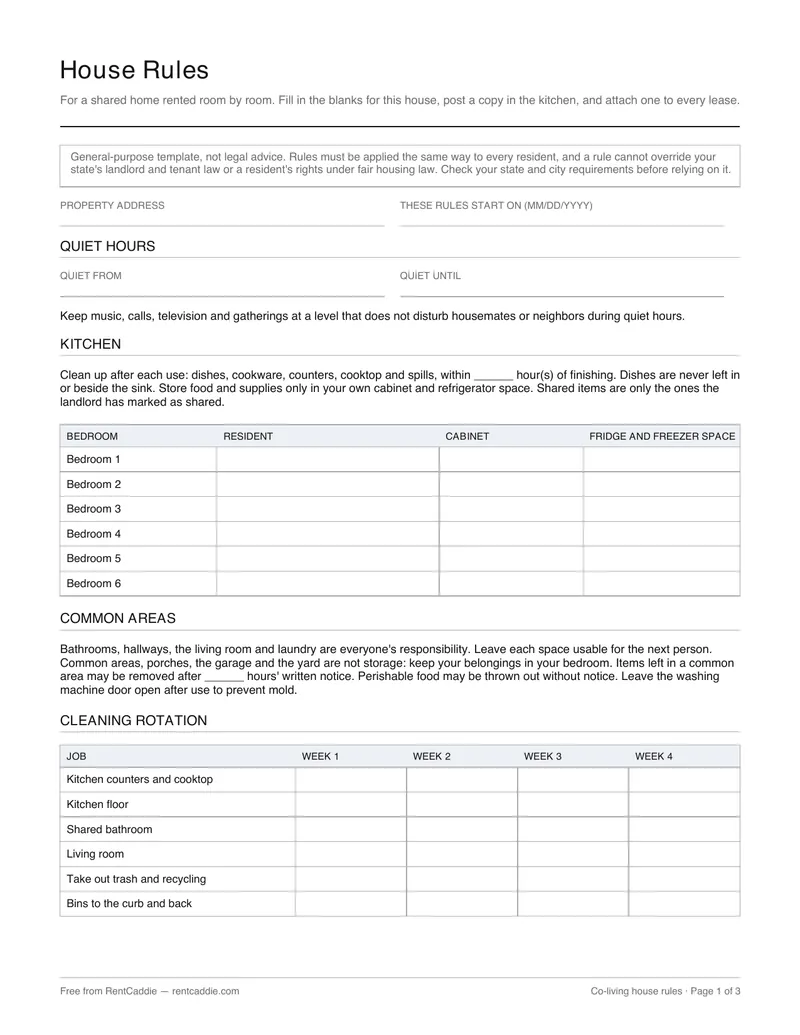
The first page of the Co-Living House Rules Template
Or skip the paper

Every step of these rules, done for you.

Cross out the paper. Here is what RentCaddie does instead, from the first signature to the last warning.

  1. 1On paper: Print the rules

    In RentCaddie: RentCaddie's co-living lease has house rules written in, so they are part of every resident's lease.

  2. 2On paper: Get every housemate to sign a copy

    In RentCaddie: Each resident signs the rules with their own lease, online, with the date and time recorded.

  3. 3On paper: Post a copy in the kitchen

    In RentCaddie: The house rules a resident signed show in their Home Guide, on their phone, whenever they look.

  4. 4On paper: Keep count of warnings

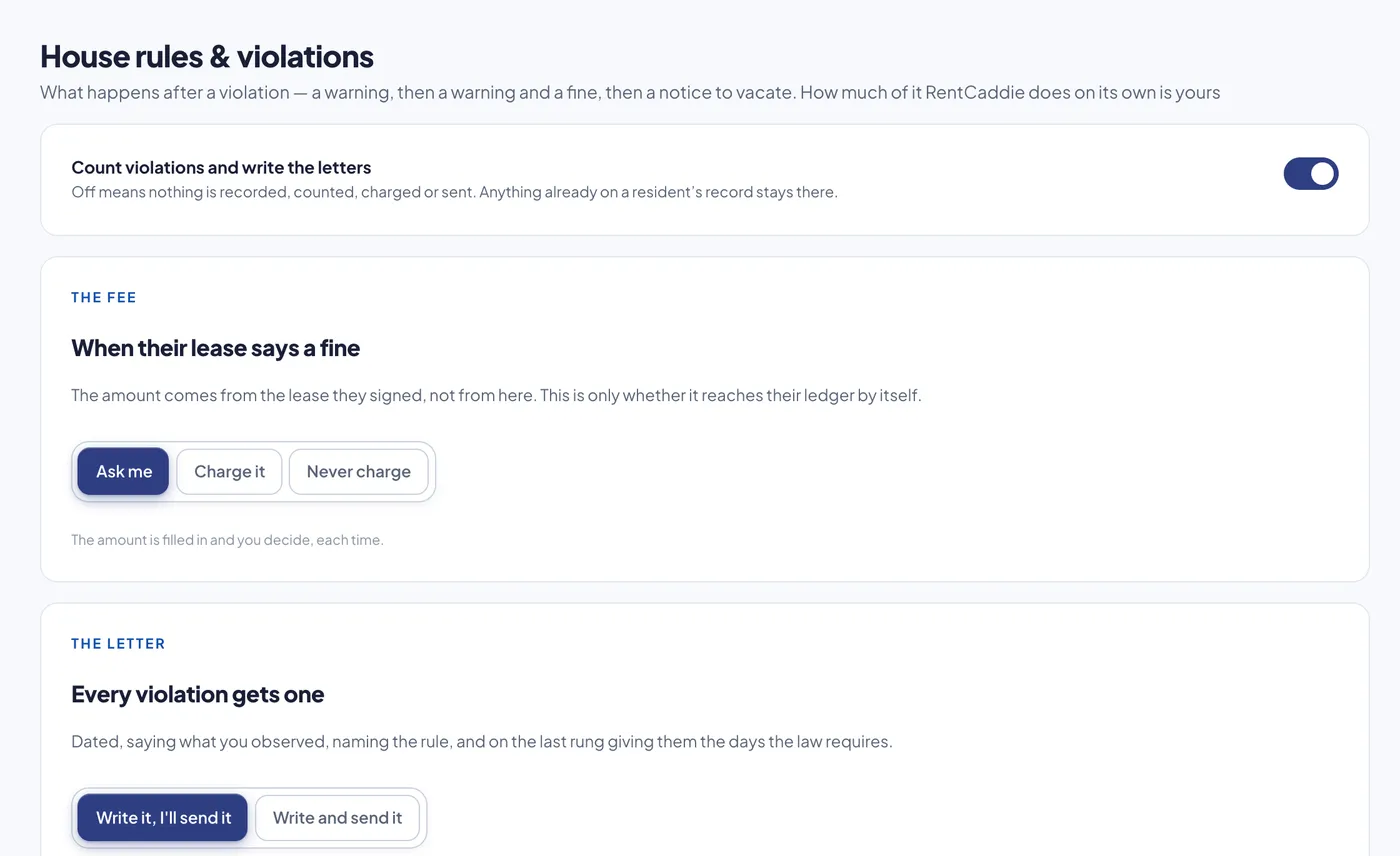
    In RentCaddie: Record what happened once. RentCaddie counts it, and shows which step they are on and what comes next.

  5. 5On paper: Write the warning letter

    In RentCaddie: RentCaddie writes the letter for each step: the date, what was seen and which rule. You read it, then send it.

  6. 6On paper: Remember who is on which step

    In RentCaddie: Old and withdrawn violations drop off by themselves, counted over the months their own lease names.

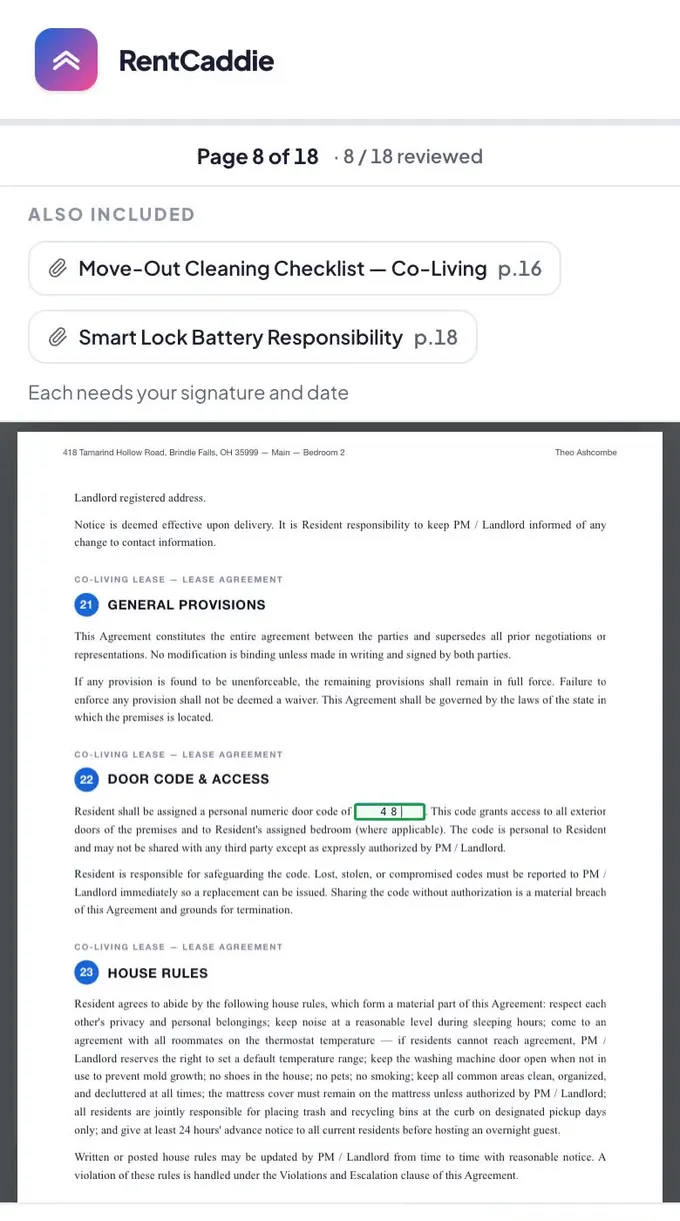
A resident's co-living lease open on a phone in RentCaddie at the House Rules clause they are about to sign.
The rules are part of the lease they sign.
  • Housemates can report a problem in the house from their phone, without naming anyone. You decide what happens next.
  • When their lease sets a fine, the amount is filled in for you to charge or skip.

Free until your first rent lands · up to 25 active leases · no credit card

What is on the form

  • Quiet hours with the times filled in for this house
  • Kitchen rules and a table assigning each bedroom its own cabinet and fridge space
  • Common-area rules, including what happens to belongings left out
  • A four-week cleaning rotation for the kitchen, bathroom, living room and trash
  • Trash day, where the bins live, and who takes them to the curb
  • Guest limits and how much notice housemates get before an overnight guest
  • Smoking, open flames, the thermostat and the home's equipment
  • Door codes, parking and internet details
  • A three-step violation process: warning, warning with a fine, notice
  • Signature lines for every resident

Rules prevent the arguments, not just settle them

Five people sharing a kitchen will each have a different idea of clean. Without a written standard, the tidiest person does all the work and resents it, and the first complaint you hear about is the third week of it. A rule that says dishes are washed within an hour turns a vague complaint into a clear yes or no.

Assigned storage does the same job for the fridge. Once each bedroom has its own shelf, food going missing becomes a specific question about a specific shelf instead of a house-wide accusation.

Make it part of the lease

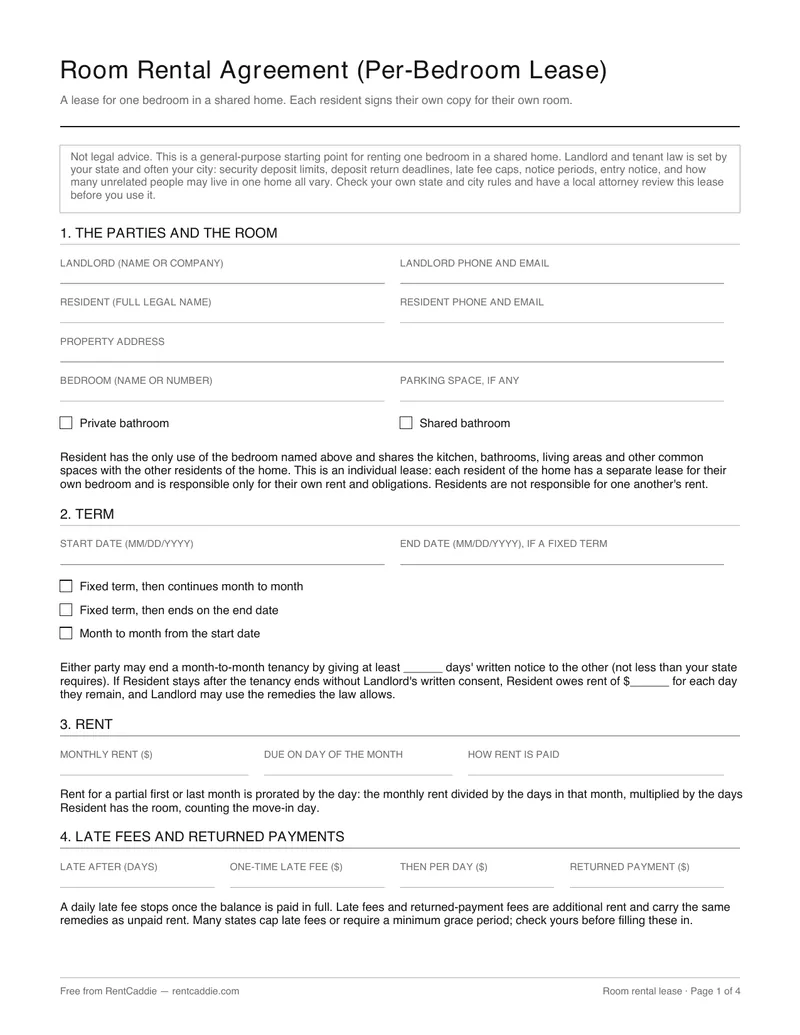
House rules only carry weight when the lease says they are part of it. Attach a signed copy to every resident's lease, post one in the kitchen, and update it with reasonable notice when something changes. The room rental lease template on this site already refers to attached house rules.

Apply every rule to every resident the same way. A rule enforced against one person and ignored for another is not a house rule, it is a grievance, and in some cases it is a fair housing problem.

  • Fill in the blanks for this house before anyone signs
  • Assign cabinets and fridge space by bedroom, not by name, so it survives turnover
  • Post the cleaning rotation where everyone sees it
  • Give every new resident a copy on move-in day

When a rule is broken

The rules end with a three-step process counted over the previous twelve months: a written warning, then a warning with a fine the lease allows, then a notice to vacate giving the time the law requires. Serious violations, such as an open flame indoors or sharing a door code, may go straight to a notice. Writing the steps down in advance is what makes the third step defensible. Check your state's rules on notices and fines before you rely on it.

Common questions

Can I fine a resident for breaking a house rule?
Only if the lease allows it, and only within your state's rules. That is why the room rental lease sets the fine as additional rent rather than leaving it to the house rules alone. Some states limit fines or how they can be collected, so check yours.
Can I change the house rules after residents move in?
Most leases, including the room rental lease template here, let the landlord update written house rules with reasonable notice. Changes cannot cut into the resident's rights under the lease or the law, and they must apply to everyone equally.
What should a cleaning rotation cover?
The shared spaces that cause the most friction: kitchen counters and cooktop, the kitchen floor, any shared bathroom, the living room, and taking trash and recycling out and the bins to the curb and back. Rotate weekly so nobody is stuck with the same job.

This form is a general-purpose starting point, not legal advice and not written for any particular state. Landlord and tenant law varies by state and often by city. Check your own state's requirements, and have an attorney review anything you plan to rely on in a dispute.