RentCaddie
Property management, on your brand
Annual plans start at $27/month. Save two months when you pay annually. Start your 14-day free trial →
Free tools

Move-out inspection checklist

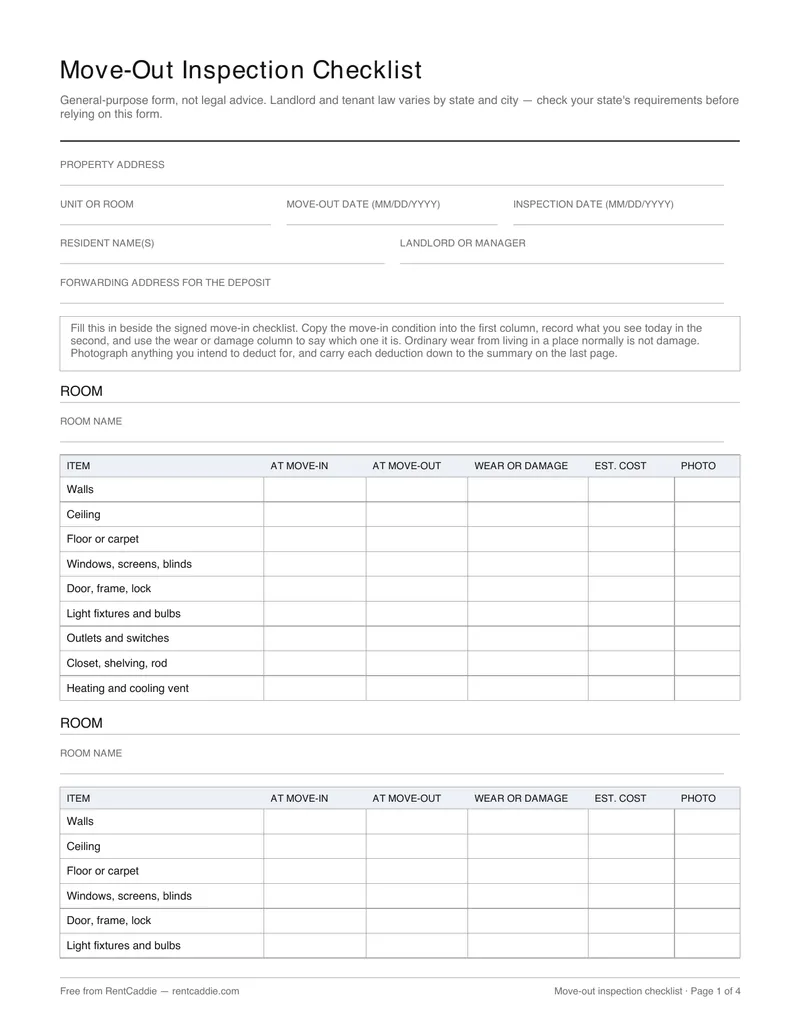
The same walkthrough as move-in, with a column for what changed. Fill it in beside the signed move-in form and your deposit accounting writes itself from a document both of you can read.

Download the PDF4 pages · Free · No email required
What is on the form
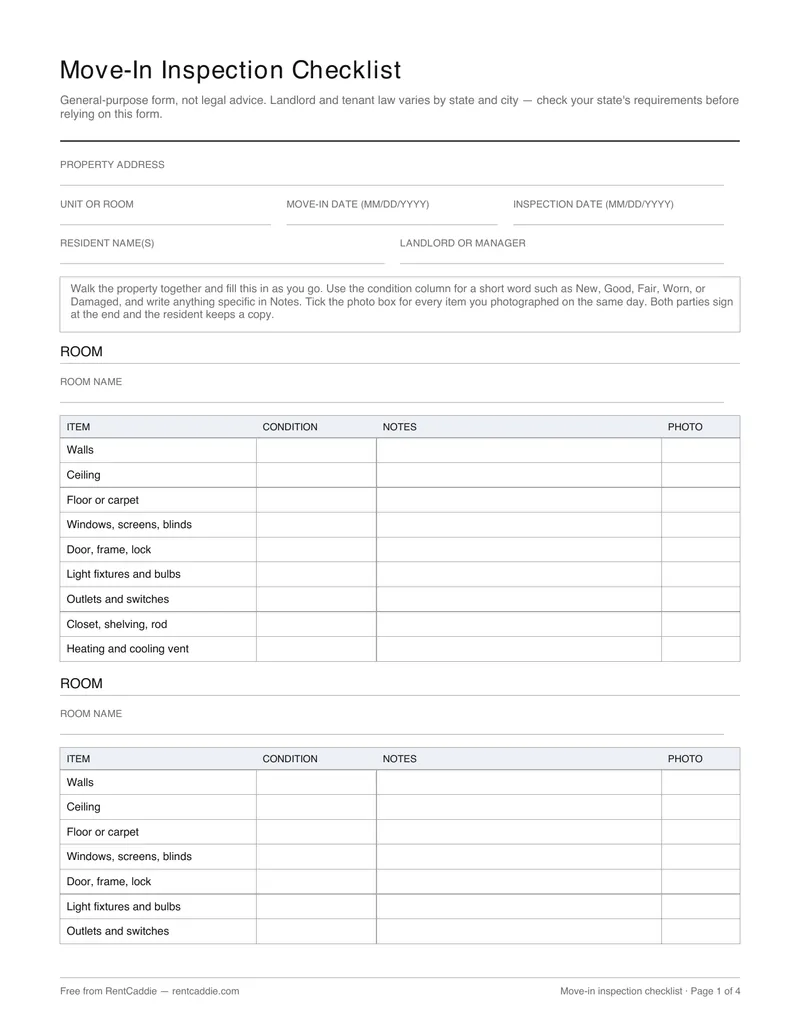
  • The same room-by-room layout as the move-in form, so the two line up
  • A condition-at-move-in column beside a condition-at-move-out column
  • A wear or damage column, so the distinction is recorded rather than argued
  • Space to note the estimated cost and whether a photo was taken
  • Cleaning, keys returned, and personal property removed
  • Final utility meter readings and forwarding address
  • A deduction summary with lines for each item and a total
  • Signature and date lines for the landlord and every resident

Normal wear is not damage, and the form should say which

The line between ordinary wear and tear and damage is where most deposit disputes actually live. Carpet flattened along a hallway after three years is wear. A burn in that carpet is damage. Faded paint is wear; a wall of holes from a mounted television is damage. Nobody argues about the extremes, they argue about the middle, and the middle is much easier to settle when you wrote down which one you thought it was at the time and why.

That is what the wear-or-damage column is for. It forces the judgment to be made and recorded on the day rather than reconstructed weeks later when a resident asks why $300 came off their deposit.

Do the deposit accounting off this form, not off memory

Once the walkthrough is done, every deduction should trace to a row on this form, and every row should trace to a photo or an invoice. A deposit statement that lists "cleaning and damage, $450" invites a challenge. One that lists four items, each with a cost and a photo reference, usually ends the conversation.

Most states also put a deadline on returning the deposit and an itemised statement, and some penalise a landlord who misses it. Fill this in on the day of the walkthrough so the clock starts against a finished document rather than a pile of intentions.

  • One line per deduction, each with a cost
  • Attach or reference the photo and the invoice
  • Total the deductions on the form itself
  • Get it done inside your state's return deadline

Check your own state's requirements

Deposit rules are state law and they vary a great deal: how long you have to return the money, what has to be itemised, whether you owe interest, and whether the resident has a right to be present at the inspection or to a second inspection before move-out. This form is a general-purpose starting point, not a jurisdiction-specific legal document. Check your state's requirements and add whatever it asks for.

Common questions

What counts as normal wear and tear?

Broadly, the deterioration that happens from living in a place normally over time: worn carpet in traffic paths, minor scuffs, faded paint, small nail holes. Damage is what results from misuse, neglect, or accident, such as burns, large holes, broken fixtures, or filth beyond ordinary cleaning. The exact line is drawn by your state's law and by how long the resident lived there.

Can I charge for cleaning?

In most places you can charge to return a unit to the cleanliness it was in at move-in, but not to charge for routine cleaning between residents as a matter of course, and several states restrict blanket non-refundable cleaning fees. The move-in form is what establishes the starting condition, which is why the two forms are designed to be read together.

Should the resident be there for the move-out inspection?

Where it is practical, yes, and in some states they have a right to be present or to request a pre-move-out inspection. It removes an entire category of dispute, because they see what you are writing down while there is still time for them to fix something.

How soon do I have to return the security deposit?

That is set by state law and ranges widely, commonly measured in days after the tenancy ends. Many states also require an itemised statement of deductions within the same window and impose a penalty for missing it. Look up your own state's deadline and treat it as hard.

This form is a general-purpose starting point, not legal advice and not written for any particular state. Landlord and tenant law varies by state and often by city. Check your own state's requirements, and have an attorney review anything you plan to rely on in a dispute.
Or stop printing forms

The same walkthrough, on your phone, filed against the lease.

RentCaddie runs inspections from your phone with photos attached to each room, signatures from you and the resident, and the record saved against the lease so you can find it at move-out. Fourteen days free.