RentCaddie
Property management, on your brand
Skip to content
Annual plans start at $27/month. 2 months free when you pay for the year. Start free →
Free tools

Lease renewal letter

A letter offering a good resident another term, with the new dates and the new rent written out, and a reply slip they sign and hand back. One page to send, one slip to keep, and no guessing in the last month about whether they are staying.

Download the PDF2 pages · Free · No email required
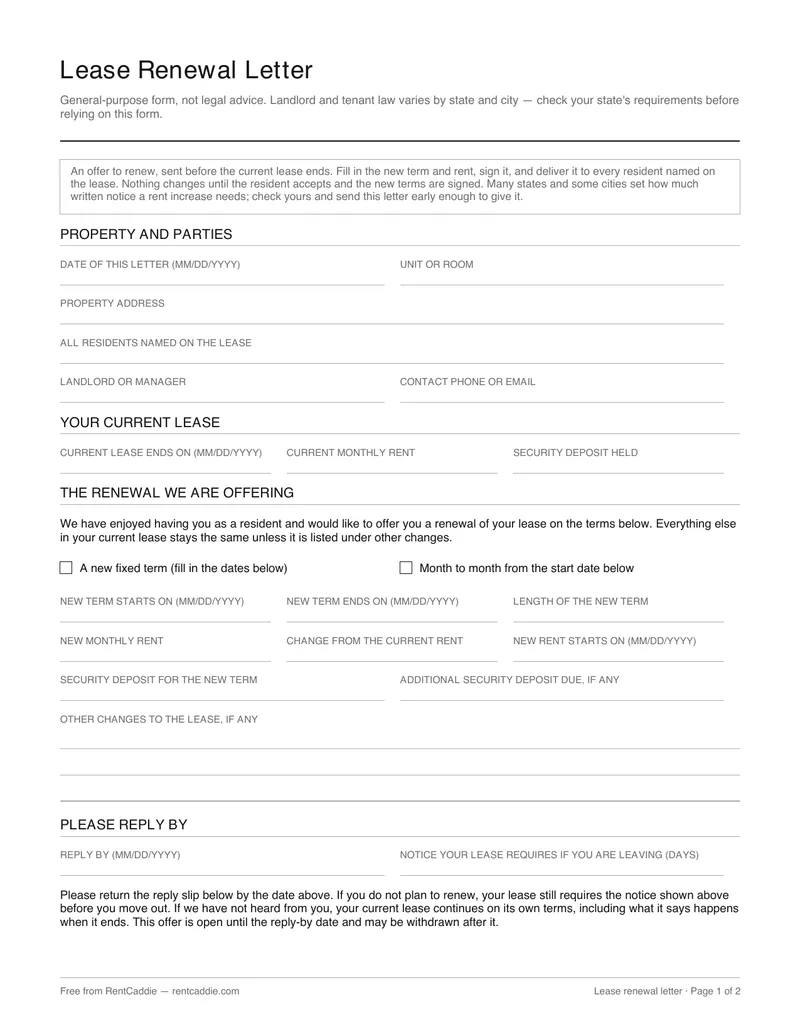
The first page of the Lease Renewal Letter
Or skip the paper

Every step of this letter, done for you.

Cross out the paper. Here is what RentCaddie does instead, from the lease that is ending to the renewal they sign.

  1. 1On paper: Remember which leases are ending

    In RentCaddie: Each lease joins your Renewals list ahead of its end date, as far ahead as you choose, and RentCaddie tells you before it ends.

  2. 2On paper: Work out the new rent

    In RentCaddie: The offer opens with the new rent worked out from your own rule: the same rent, a percentage more or a dollar amount more. You can change it.

  3. 3On paper: Type up the letter

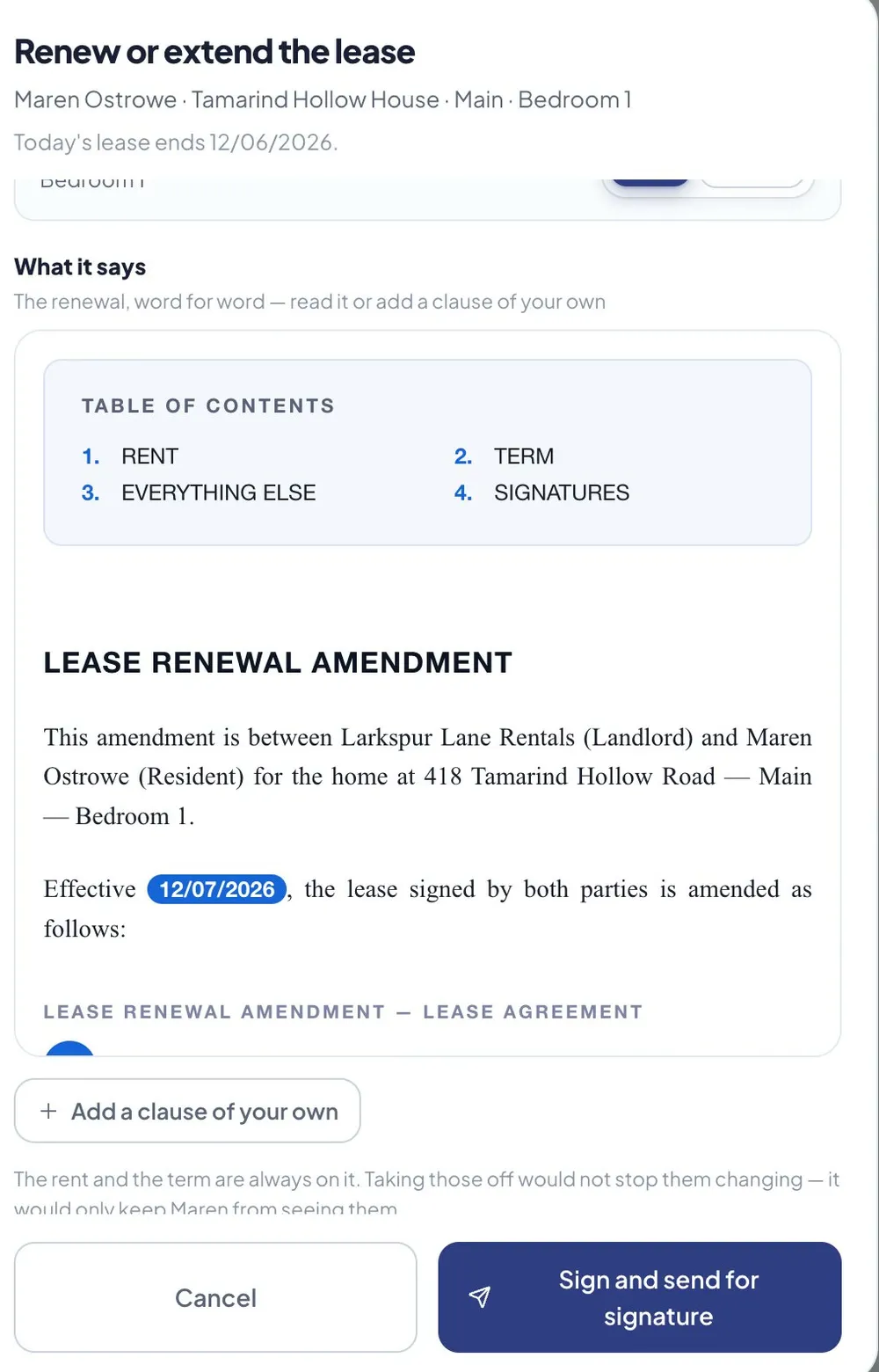
    In RentCaddie: The renewal is written for you, word for word, with the new term and rent. You sign it once and send it.

  4. 4On paper: Deliver it and wait

    In RentCaddie: Everyone on the lease gets it by email and on their resident page. Anyone who has not answered gets one reminder.

  5. 5On paper: Collect the reply slip

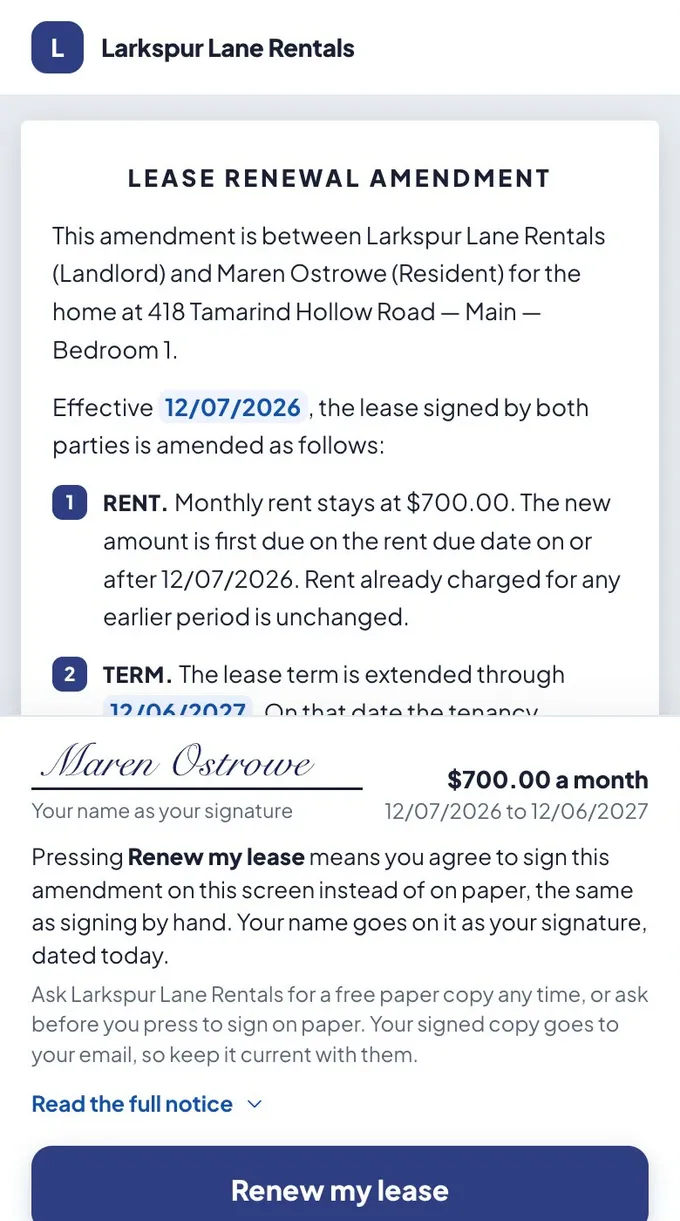
    In RentCaddie: From their phone, they renew and sign, ask you a question, or say they are not renewing. Each answer shows on their record.

  6. 6On paper: Update the lease and the rent

    In RentCaddie: Once they sign, the new end date is on the lease, and the new rent starts billing on the day the new term starts, not a day sooner.

A resident's lease renewal open on a phone in RentCaddie: the new term, the rent, their typed signature and a Renew my lease button.
Your resident renews from their phone.
  • When a resident says they are not renewing, you are told at once.
  • Not renewing someone? From their record, email everyone on the lease a not-renewing notice with their last day.

Free until your first rent lands · up to 25 active leases · no credit card

What is on the form

  • The property, the unit or room, and every resident named on the lease
  • The current lease end date, the current rent and the Security Deposit held
  • The renewal on offer: a new fixed term or month to month, with exact dates
  • The new monthly rent, the change from today's rent and the day it starts
  • The Security Deposit for the new term, and any extra amount due
  • Space for any other change to the lease, so nothing is agreed out loud
  • A reply-by date and the notice the lease requires if they are leaving
  • A reply slip: accept, talk first, or not renewing with a last day and forwarding address
  • A delivery record, including the day the reply came back

Why a renewal deserves a letter, not a text

Most renewals go wrong quietly. The manager mentions it in passing, the resident says they will probably stay, and two weeks before the lease ends nobody knows whether the rent is going up, whether the lease runs month to month, or whether the room needs to be listed. A written offer turns probably into yes or no, by a date you both know.

It is also the cheapest way to keep a good resident. An empty room costs rent for every day it sits empty, plus cleaning, photos and showings. A clear offer sent early, at a fair rent, is usually the best money a landlord spends all year.

  • Name every resident on the lease, not just the one who pays
  • Write exact dates for the new term, never just a month
  • State the new rent and the day it starts
  • Give a reply-by date that leaves time to list the room if they say no

Raising the rent at renewal

A renewal is the usual time to change the rent, and the letter puts the new figure beside the old one so there is no surprise. Show the change in dollars, not only as a percentage, and say the exact day the new rent starts. The current rent stays in force until then.

How much notice an increase needs, and in some places how large it may be, is set by state and city law, not by the lease. Some cities have rent stabilization or rent control rules that limit an increase or require specific wording. Look up the rule where the property is and send the letter early enough to give the full notice period.

Check your own state's requirements

Renewal rules vary by state and city: how much notice a rent increase needs, whether a fixed-term lease rolls into month to month on its own, how much notice a landlord must give to decline a renewal, and whether some residents have a right to renew at all. This letter is a general-purpose starting point, not a jurisdiction-specific legal document. Check what your state and city require before you send it.

An accepted reply slip shows the resident agreed. Follow it with a signed renewal addendum or a new lease, so the new term and rent are part of the lease itself rather than a separate piece of paper.

Common questions

How far ahead should I send a renewal letter?
Early enough to give whatever notice your state or city requires for a rent increase, and early enough that a no still leaves you time to list the room. Check your own state's rule and your lease's notice period, then work back from the day the lease ends to pick the date you send it.
What happens if the resident never replies?
The offer simply runs out on its reply-by date and the current lease continues on its own terms, including whatever it says happens when it ends. Many leases roll into month to month. Follow up once in writing before the reply date rather than assuming a yes or a no.
Is a signed reply slip enough to renew the lease?
It is written proof the resident accepted your terms, which is far better than a conversation. The clean finish is a signed renewal addendum or a new lease for the new term, so the new dates and rent are written into the lease itself. Your state may have its own rules on what a renewal needs.
Can I change other terms at renewal, not just the rent?
Usually yes, because a renewal is a new agreement for a new term. List every change in the other changes section so nothing is agreed out loud, and apply the same rules to every resident in the same situation. Any change still has to follow your state and city law.

This form is a general-purpose starting point, not legal advice and not written for any particular state. Landlord and tenant law varies by state and often by city. Check your own state's requirements, and have an attorney review anything you plan to rely on in a dispute.