
Price a rent-by-the-room house from the bottom up, not by dividing a whole-home rent. Find what a private bedroom actually rents for near you, rank your bedrooms against each other by size, bathroom access, and light, set a separate asking rent for each, decide exactly what the rent includes, and then check that the four asking rents together beat the whole-home rent by enough to pay for the extra work.
Key takeaways
- Comparable rents come from room listings and shared-house listings, not from whole-home listings divided by the bedroom count.
- Rank your own bedrooms first; the spread between the best and worst room is usually 20% to 30% of the best room's rent.
- Decide what is included — utilities, internet, furniture, cleaning — before you set a number, because it changes the number.
- Compare the room total against the whole-home rent after vacancy, shared bills, and the extra turnover work.
- Re-check the weakest room first when a room sits empty; the top room is almost never the problem.
Start with what a room rents for, not what a house rents for
The most common pricing mistake in shared housing is arithmetic: take the $1,600 the whole house would rent for, divide by four bedrooms, and call it $400 a room. That number is almost always wrong in both directions. A private bedroom is a different product from a whole house, and it competes against other private bedrooms — not against three-bedroom rentals.
Gather comparables the way a renter shops. Search your city plus the words room, private room, and shared house on the sites renters in your market actually use, and write down what each listing includes: the room's size, whether the bathroom is private or shared, whether utilities and internet are in the rent, whether it is furnished, and the minimum term. Ten honest comparables beat fifty you did not read.
For a sanity check on the whole-home side, HUD publishes Fair Market Rent figures by area and bedroom count, and the Census Bureau's American Community Survey publishes local rent and household data. Neither is a room-level price, but together they tell you whether your read on the market is roughly in the right neighborhood.
- Search room listings, not home listings
- Record what each comparable includes
- Note the term length and deposit
- Note private versus shared bathroom
- Keep the screenshots with your pricing notes
Rank your own bedrooms before you price any of them
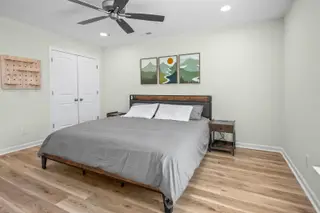
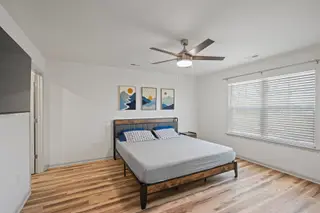
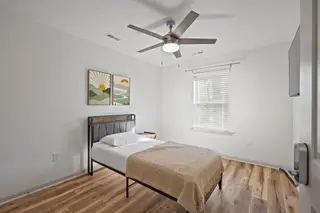
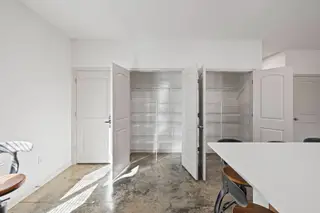
Walk the house and put the bedrooms in order, best to worst, before a dollar figure enters the conversation. Rank on the things a renter can see on a tour: floor area, window count and light, closet space, how far the bedroom is from a bathroom, whether that bathroom is private or shared, noise from the street or the living room, and whether the door is on a hall everyone walks down.
Then set the top room from your comparables and work down. In most four-bedroom houses the spread from best room to worst is meaningful but not enormous — commonly somewhere between 20% and 30% of the top room's rent. A $750 primary bedroom with its own bathroom sitting beside a $525 small interior bedroom is a normal-looking ladder. A house where every bedroom is priced identically is a house where the small room stays empty and the big room is underpriced.
Write the reason for each price next to the number. When a room sits empty for three weeks you want to reread why you thought it was worth $600, not re-derive it from scratch.
- Floor area and usable wall space
- Windows, light, and street noise
- Private bathroom, shared bathroom, or hall bathroom
- Closet and storage
- Parking space included or not

Decide what the rent includes before you set the number
In shared housing the inclusions are half the price. A furnished bedroom with electricity, water, gas, internet, and a monthly common-area clean is a materially different offer from an empty bedroom where four residents split four bills, and it should not carry the same rent. Pick the package first, then price it.
If you include utilities, price them from twelve months of real bills for that house, not from a guess, and add a margin for the month someone runs the air conditioning with a window open. If you split them instead, write the split method into the lease before the first bill arrives — an equal split, a split by occupied rooms, or a submetered usage charge. Some jurisdictions regulate how utility costs may be rebilled and what has to be disclosed, so check your local rules and keep the source bill beside each resident's share.
Furniture is worth paying for in markets with short stays and travelling workers, and worth skipping in markets where residents arrive with a life already packed. The honest test is whether furnished listings near you are actually renting, not whether furnished listings exist.
- Utilities included at a flat amount
- Utilities split by a disclosed method
- Internet included
- Furnished or unfurnished
- Common-area cleaning included
- Parking included
Check the whole-house math before you commit
Add the four asking rents. In a four-bedroom house priced at $750, $600, $600, and $525, that is $2,475 a month of scheduled room rent against a $1,600 whole-home rent. The gap is not profit yet: subtract the utilities and internet you now pay, the common-area cleaning, the extra wear on shared spaces, and the vacancy you will carry on individual rooms.
Model vacancy per room, not per property. If each bedroom is empty an average of three weeks a year, a four-bedroom house loses roughly twelve room-weeks — call it $600 to $700 of the annual total at these rents. That is the number that decides whether room-by-room is worth it for a given house, and it is the number a whole-home occupancy figure hides completely.
Then do the same arithmetic on the work. Four leases, four deposits, four move-ins, four sets of screening, four door codes, and four move-outs a year is a different operating load from one. If the spread after vacancy and shared bills does not comfortably pay for that load, the house is a better whole-home rental and there is no shame in saying so.
- Scheduled room rent, added up
- Minus utilities, internet, and shared cleaning
- Minus modeled per-room vacancy
- Minus the extra leasing and turnover work
- Compared against the whole-home rent
Adjust from real signals, one room at a time
After the listing goes live, the market answers within two weeks. Inquiries with no tours usually mean the photos or the description are wrong. Tours with no applications usually mean the price is above what the room shows as. No inquiries at all usually means the price is well above the market or the listing is not where renters are looking.
Adjust the weakest room first. The instinct when a house is not filling is to cut the top room, because it is the biggest number on the page; the top room is almost never the one holding up the house. Move the bottom room down until it fills, and leave the ladder above it intact.
Once the house is full, keep a short record per room: what it rented for, how many days it took, and what the resident said about it on the tour. Two turnovers of that record tells you more about your own bedrooms than any market report will.
- Inquiries per room per week
- Tours booked and tours held
- Days from listing to signed lease
- Achieved rent versus asking rent
- Reason given by applicants who passed

Review the ladder every time a room turns
A price set once and never revisited quietly drifts out of the market. Every time a bedroom turns over you get a free read: how many inquiries it drew, how many tours converted, how long it took, and what it actually rented for. Keep those four numbers per room and the ladder maintains itself, because you are comparing your own rooms against your own history rather than against a market report written for whole homes.
Watch the gap between rooms as well as the numbers themselves. If the smallest bedroom consistently fills in four days and the mid-tier rooms take three weeks, the small room is underpriced and the middle of the ladder is compressed. Widening the spread — rather than cutting every room — usually fixes the house without giving away the rent the strong rooms can carry.
- Days on market by room
- Inquiries and tour conversion by room
- Achieved rent versus asking rent
- Spread between the top and bottom room
- What the resident said the room was worth
Put the process into operation
Turn the guidance into a named workflow with a trigger, accountable owner, required evidence, target time, exception path, and definition of done. Store the checklist where the work happens; a policy document nobody sees during the task will not create consistency.
Pilot the workflow on one property or one cycle, review what was unclear, and update the template before wider rollout. Then schedule a monthly exception review so the system improves from real late, missing, disputed, or reopened work instead of relying on memory.
- Comparable rents come from room listings and shared-house listings, not from whole-home listings divided by the bedroom count.
- Rank your own bedrooms first; the spread between the best and worst room is usually 20% to 30% of the best room's rent.
- Decide what is included — utilities, internet, furniture, cleaning — before you set a number, because it changes the number.
- Compare the room total against the whole-home rent after vacancy, shared bills, and the extra turnover work.
- Re-check the weakest room first when a room sits empty; the top room is almost never the problem.
Common questions
How much should I charge per bedroom?
Is renting by the room more profitable than renting the whole house?
Should every bedroom cost the same?
Should I include utilities in room rent?
How do I price a room with a private bathroom?
Rental language, explained
Every term linked above, with a plain-English definition and a practical property-management example.
Browse the full property management glossarySources and methodology
Written to help independent landlords make an operational decision. Legal and tax topics are educational, not professional advice. Comparison claims use public vendor information; we do not invent hands-on testing.